
Bench Warrants in Grundy County
A Grundy County bench warrant is a judge's command tied to a case already before the court. Common triggers include a missed required appearance, failure to appear for sentencing, contempt, or noncompliance with an order. An unpaid balance may be part of the history, but debt alone should not be called a bench warrant without a case entry or court confirmation.
The matter may sit before an Iowa judicial magistrate, district associate judge, or district judge within Iowa District Court, Grundy County. Iowa sources use bench warrant, arrest warrant, and failure-to-appear warrant. Capias and capias pro fine were not verified as routine Grundy County labels.
Missed Appearance to Grundy Warrant Entry
The timeline begins with a citation, complaint, notice, or order that requires action. If the person misses the setting or fails to comply, the court records that event. A judicial officer may then issue a bench warrant or, for willful failure to appear on a citation, an arrest warrant under Iowa Code §805.5.
The Clerk maintains the docket while the warrant is sent for enforcement. Later entries can show service, return, initial appearance, bond, a reset, recall, quash, or disposition. Read the whole sequence. An old warrant entry can remain in the history even after a later order changes its status.
How a Grundy County Bench Warrant Is Issued
The judicial officer handling the case decides whether the missed duty calls for a warrant and what the order authorizes. The Clerk records the event and the serving agency receives enforcement information. The Grundy sheriff, city police, or another peace officer may execute it, but the issuing court retains control over recall or quash.
Authorized agencies may exchange warrant data through the restricted Iowa On-line Warrants and Articles System. The public cannot search that network. Public checking starts with Iowa Courts Online, then calls to the Grundy County Clerk and sheriff.
Grundy Bench-Warrant Court Roles
Iowa judicial magistrates handle traffic, simple misdemeanors, county and municipal infractions, small claims, preliminary hearings, and search-warrant duties. District associate judges have magistrate jurisdiction plus specified misdemeanor and class D felony authority. District judges hold general trial-court authority.
- Issuing court
- The court with authority over the case and warrant order.
- Failure to appear
- A required court appearance was missed.
- Recall
- The issuing court withdraws its warrant order.
- Quash
- The court sets the warrant aside through judicial action.
The Clerk provides practical routing, but cannot give legal advice or draft a motion.
Grundy Bench Warrant vs Arrest Warrant
Both instruments can authorize custody, but they begin differently. A new arrest warrant follows a complaint or affidavits establishing probable cause that a named person committed a public offense. A bench warrant generally follows a missed appearance, sentencing duty, contempt issue, or other failure within an existing case.
| Feature | Bench Warrant | Arrest Warrant |
|---|---|---|
| Trigger | Missed appearance, contempt, or noncompliance | Probable cause for a public offense |
| Issued by | Judicial officer in an existing case | Magistrate reviewing complaint or affidavits |
| Case posture | Usually an existing filed matter | May begin or advance a criminal case |
| Next step | Recall, reset, appearance, or bond direction | Service, surrender, booking, and release procedure |
Grundy Court Debt Is Not Always a Warrant
A past-due fine and a warrant are linked only when the docket and court action connect them. Iowa traffic debt can affect license status after required notices, and a missed appearance can lead to FTA consequences. Still, a balance on the payment portal does not prove a bench warrant is active.
Check the event: Ask whether the case shows court debt, a missed setting, an active warrant, or more than one of these.
If payment is available, ask whether it is sufficient or whether a hearing, bond, or recall is also needed. Online payment can amount to a guilty plea and cannot replace a required appearance.
How to Resolve a Grundy Bench Warrant
Start with the issuing case, not an unverified payment demand. The court controls recall or quash, while the sheriff can explain service, surrender, and booking. No Grundy County recall form, filing fee, warrant walk-in schedule, or bond counter was found in official sources.
- Confirm the case, warrant status, and issuing judicial officer with the Clerk.
- Ask an Iowa attorney about recall, quash, reset, or an arranged appearance.
- Call the sheriff before surrender and ask about place, time, identification, booking, and bond.
- Complete the required payment, hearing, plan, filing, or other obligation, then verify the docket.
Before appearing: Call the issuing court and sheriff, seek legal advice, and never assume that paying debt automatically recalls a warrant.
Call the Grundy Clerk Before Walking In
The Grundy County Clerk of Court is at 706 G Avenue in Grundy Center and can be reached at 319-824-5229 or countyclerk.grundy@iowacourts.gov. Ask whether the docket is current, which court issued the warrant, whether a hearing is required, and whether the file must be viewed at the courthouse terminal.
The official Grundy court directory provides the local office context.
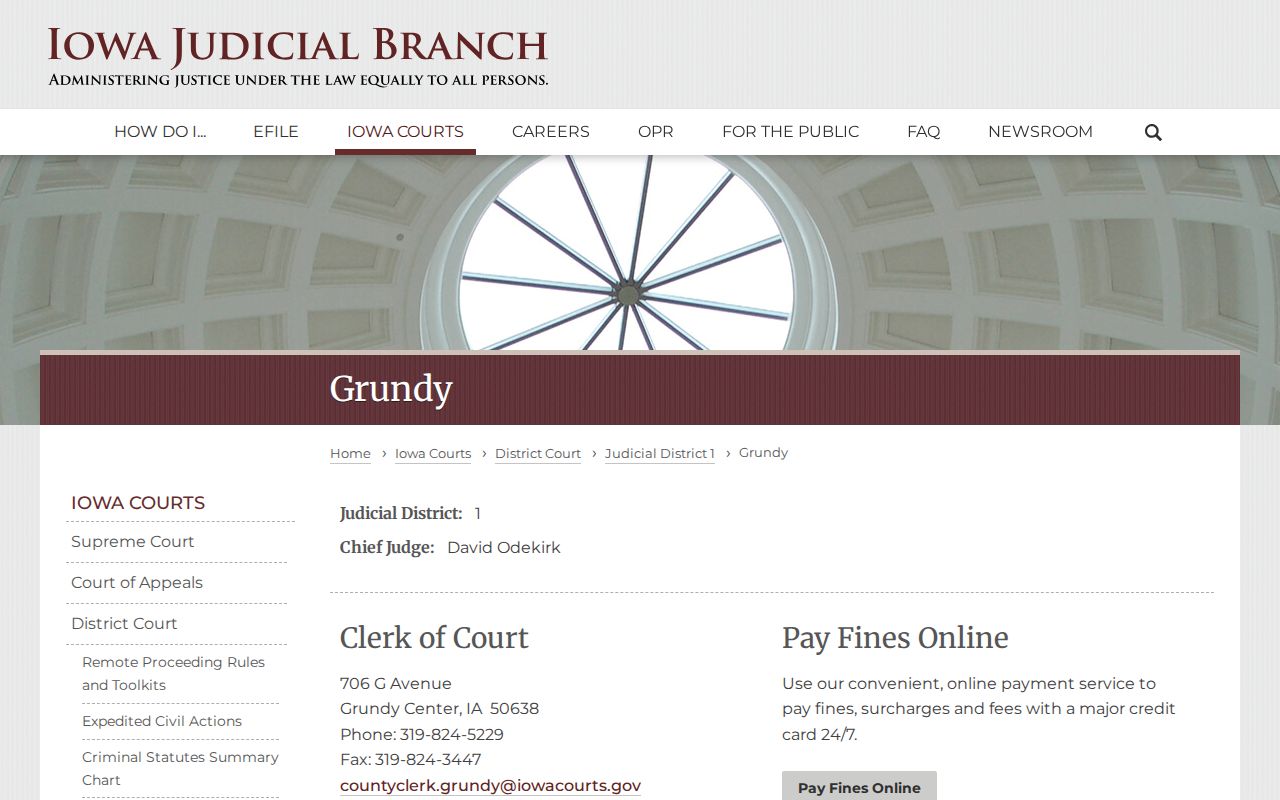
Then call the sheriff routine line. Neither office publishes a warrant-specific walk-in or bond schedule, so current instructions matter.
Which Grundy County Court Issued It
Only the issuing court can change its bench-warrant order. The sheriff may serve the warrant and explain custody steps, but it cannot promise a recall. Use the case caption, citation, docket, or Clerk confirmation to identify the judicial officer and Grundy filing.
Grundy County has no verified separate municipal-warrant court. Under Iowa Code §364.22, an original municipal-infraction citation goes to the district-court clerk and is tried before a magistrate, district associate judge, or district judge. A city clerk may explain an ordinance or hold a citation copy, but the district-court case remains the core record.
After a Grundy Bench Warrant Clears
Check for a specific court action showing recall or quash. A payment receipt, bond posting, or new court date can be important without proving the warrant itself changed. Ask when the Clerk expects the docket to update and when the sheriff should receive the new status.
Keep any order, receipt, plan, and confirmation screen. If the case comes from another Iowa county, contact that county's clerk and agency. If it is federal or out of state, ask counsel or the sheriff about the originating jurisdiction. Grundy offices cannot clear another court's warrant merely because the person lives or was stopped locally.
When the Grundy Bench-Warrant Search Is Blank
A missing online result can have several explanations. A filing may still be within the citation posting lag. The warrant may be new, the application may be protected, the case may be juvenile, or another Iowa county or federal court may hold it. Iowa Courts Online is a docket index rather than a live warrant roster, and the restricted IOWA System has no public login.
Call the Clerk at 319-824-5229 with the full legal name, date of birth, exact case or citation number when known, approximate date, and issuing city or agency. Ask whether the docket is current, whether an FTA or warrant entry is publicly available, and what court action comes next. Then ask the sheriff at 319-824-6933 about publicly releasable service and surrender information.
A records request can seek a defined public document, but it is not a shortcut around a sealed file. Under Iowa Code chapter 22 and Judicial Branch policy, identify the case, record type, date range, and preferred format. Court requests go to the Clerk. Sheriff-held requests go to the sheriff's lawful custodian. Copy, postage, staff, review, redaction, or programming charges may apply.
Scam demands require care. The Iowa Judicial Branch warned in 2026 that callers may invoke a warrant or jury service and seek personal information, prepaid cards, bitcoin, or money through a phone number they supply. Confirm the case first. Court payments go through the Clerk, Iowa Courts Online, or the official payment line, and only when the court says payment is the proper step.
If the problem began with a city citation, a city clerk may explain the ordinance or parking exception. That clerk does not replace the Grundy district-court record when a municipal infraction has been filed under Iowa Code §364.22. Ask which record controls before treating city payment as a warrant recall.
The same caution applies after a reset or new hearing date. Ask whether the judge entered a separate recall order, whether bond remains in place, and whether the sheriff received the change. Keep the order and note the date of confirmation. A new setting can move the case forward without removing an older warrant command. Confirm each part separately with the issuing court.